THE SOCIETY FOR MEDIEVAL ARCHAEOLOGY exists to further the study of the period from the 5th to the 16th century A.D. by publishing a journal of international standing dealing primarily with the archaeological evidence, and by other means such as by holding regular meetings and arranging conferences. While maintaining a special concern for the medieval archaeology of Britain and Ireland, the society seeks to support and advance the international study of this period (as broadly defined above) in Europe. It also aims to serve as a medium for co-ordinating the work of archaeologists with that of historians and scholars in any other discipline relevant to this field.
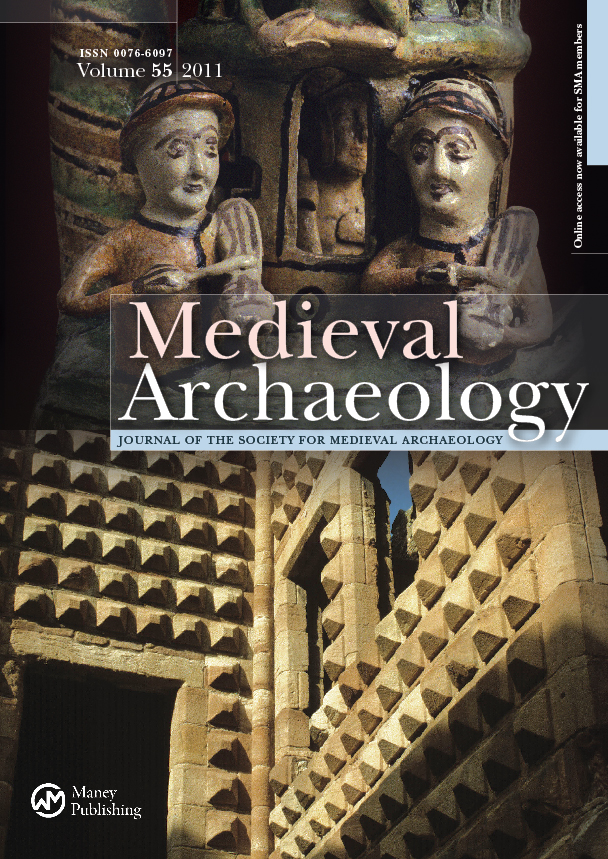
Members receive Medieval Archaeology, the Society's journal (published annually), together with a twice-yearly newsletter.
The Society for Medieval Archaeology Postgraduate Colloquium
On February 19th and 20th 2010, the Society will be hosting its annual postgraduate colloquium
conjunction with the University of Birmingham
research and discuss their findings over a two-day conference. The conference is designed as a
forum for informing others about your research, as well providing a research environment within
which students can develop ideas and make new contacts. Click here for the programme and further details.
THINGS MEDIEVAL
A conference in tribute to Alan Vince
at the lecture theatre of the
Museum of London
27th of February 2010
The Society for Medieval Archaeology and the Medieval Pottery Research Group are co-hosting a one-day conference in memory of Alan Vince, a great archaeologist and a fine ceramicist, who died in February 2009.
The programme addresses three themes that represent Alan’s major interests; towns, trade and ceramics. The aim is to look forward with new approaches, ideas and interpretations as well as reflecting on the great contribution Alan made in all these areas of our discipline.
There will be three speakers talking to each theme, including Paul Blinkhorn, Duncan Brown, Christopher Dyer, Christopher Gerrard, David Hinton, Maureen Mellor, David Stocker and Mats Roslund.
Click here to download the Conference Announcement and the Conference Programme.
|

We welcome Dr Niall Brady of The Discovery Programme, Ireland, as our new newsletter editor and bring you, we hope, the first of many instalments. The present year has been a busy year for the Society, and the Newsletter serves to capture the essence of those events that are of interest to the membership. With news, views, reports on conferences and fieldtrips, you can find the latest edition here.
Major residential conferences are held every other year, alternating with a one-day conference, usually held in London.
The Annual General Meeting, also held in London, in early December, is followed by the Annual Lecture, given by medieval archaeologists of international stature.
The Society administers a series of funds which award grants and bursaries to society members.
|
 |
New Student Discussion List
A Discussion list for student members of the Society for Medieval Archaeology is now available. Members of the Society's Council will distribute information here about forthcoming Society events, and other events that may be of interest to student members of SMA. Subscribers to this list should be student members of the Society for Medieval Archaeology or members of Council. All are welcome to discuss or promote matters of interest to medieval archaeologists. Please note that all views expressed here are personal to the author of the email and do not necessarily represent the views of the Society for Medieval Archaeology. To subscribe to this list please go to the following url:
http://lists.shef.ac.uk/sympa/info/sma-students
If you have any problems registering please contact the Honorary Secretary, Dr Dawn Hadley.
A ‘lost’ palace of the bishops of Winchester
Our current special feature is a contribution from Society Member Nicholas Riall who goes in search of the 'lost' palace of the bishops of Winchester. To read more, click here.

Winchester Palace 1828
RETROSPECT and PROSPECT
2007 marked the fiftieth birthday of the Society for Medieval Archaeology. It was on the afternoon of Tuesday 16th April 1957 at Burlington House, Piccadilly, that Donald Harden, the newly appointed Director of the London Museum , first outlined proposals for a new ‘society for Dark Age and Medieval Studies’. The idea was a simple one; a new society with a new journal, occasional meetings and an annual conference, all to be dedicated to the period ‘from the end of the Roman period until the end of the Middle Ages in Britain. To read more of Christopher Gerrard's article celebrating 50 years of The Society for Medieval Archaeology click here.
John Hurst Award
The Society for Medieval Archaeology awards the first John Hurst Award to the undergraduate dissertation that makes the most original contribution to medieval archaeology (from AD400 to 1500). Download an interview with one of the Society for Medieval Archaeology’s founding members from the Society of Antiquaries of London website.
The interview with John Hurst is the first in what will be a series of interviews that can be listened to online or downloaded and listened to on a computer or MP3 player, such as an iPod. He will be talking about his childhood interest in archaeology, his Cambridge education, his first excavations and his growing interest in deserted medieval villages at a time when historians were denying that they even existed. Click here to read more and find out more about the award here.
The Medieval Archaeology Gallery
As a special feature, the Society for Medieval Archaeology Website will be exhibiting a gallery of slideshows.
Society members were asked to submit a series of images that depicted some of the fascinating work they have carried out in the field of Medieval Archaeology. More details about these members can be found on the projects page.
|
To launch this new feature we have chosen a wonderful selection of photographs exhibited with the kind permission of Historic Scotland. The Society for Medieval Archaeology welcomes more submissions and would like to build a collection of photographic, diagramatic and cartographic images that document the research work of Society members. If you have a selection of images or illustrations, accompanied by a short summary, web links and captions, please do contact us. |
 |
|
|
|